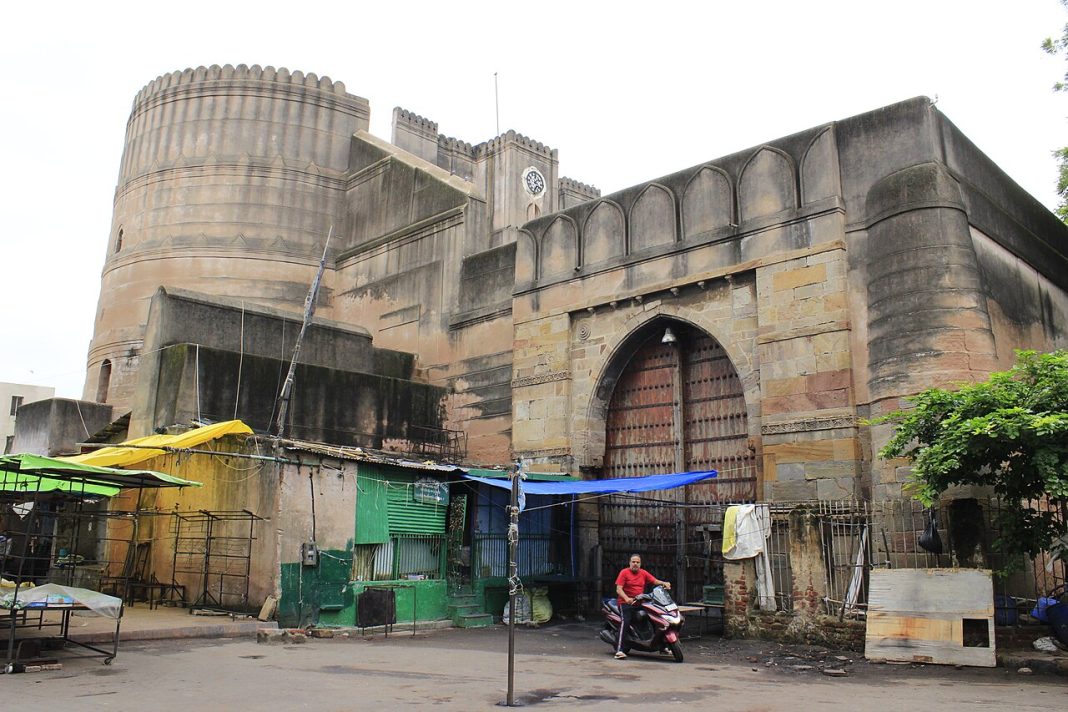

Bhadra Fort stands as the historical heart of Ahmedabad, a 614-year-old fortress that marks the founding moment of the city itself. Built in 1411 by Ahmed Shah I on the eastern bank of the Sabarmati River, this imposing structure served as the royal palace, administrative center, and defensive stronghold of the Gujarat Sultanate. As of 2025, Bhadra Fort remains a UNESCO World Heritage Site and a compelling destination for those seeking to understand Ahmedabad’s medieval origins.
The founding of Ahmed Shah’s capital
Table of Contents
Ahmed Shah I, the third ruler of the Muzaffarid dynasty, chose the Sabarmati River valley to establish his new capital. The decision to abandon the earlier capitals and construct an entirely new city was momentous, and Bhadra Fort became the physical manifestation of this ambition. The fort’s construction began in 1411 CE, marking year one of what would become one of India’s most significant medieval cities. Learn more about Ahmedabad’s history on Wikipedia.
The original fort enclosed approximately 43 acres, making it a substantial royal complex even by Sultanate standards. The construction was rapid for its time, with the fort and its protective walls completed within a few years. The fort contained approximately 162 houses initially, suggesting it was not merely a military fortification but a complete urban enclosure where the royal family, administration, and military elite resided together.
Architectural layout and purpose
The fort was designed with multiple functions in mind. The outer walls provided military defense, while the interior contained palace structures, administrative buildings, and residences. Unlike European castles with high towers, the fort emphasized horizontal space and interior courtyards, reflecting Islamic and Indian architectural traditions. The primary entrance was the Teen Darwaja (Triple Gateway), an architecturally sophisticated triple-arched structure that required four years to complete (1411-1415).
The Teen Darwaja was not merely functional but ceremonial, serving as the formal gateway to Maidan Shah, the royal square where state events, assemblies, and public gatherings occurred. The gateway’s design, with its three arches diminishing in size, creates visual perspective and directs movement toward the interior courtyards. Today, Teen Darwaja remains one of Ahmedabad’s most photographed and recognized monuments.
The fort’s layout followed Islamic palatial traditions, with separate quarters for different functions and hierarchies. The proximity of the Bhadra Kali Temple within the fort indicates the complex relationship between the Islamic sultanate and local Hindu populations, showing how power structures accommodated existing religious practices.
Key structures within Bhadra Fort
| Structure | Period | Purpose & Details |
|---|---|---|
| Main Fort Wall & Gates | 1411-1415 | Defensive perimeter with eight original gates |
| Bhadra Kali Temple | Sultanate Era | Goddess Kali shrine, presently very popular & pilgrimage site |
| Ahmed Shah’s Mosque | 1424-1437 | Jama Masjid, adjoining fort, one of largest Sultanate mosques |
| Clock Tower | British Era | Victorian-era addition, iconic landmark |
| Azam Khan’s Sarai | 1637 | Mughal caravanserai, later converted to temple |
| Royal Pavilions | Sultanate Era | Administrative & ceremonial structures, partially ruins |
| Maidan Shah | 1411+ | Royal square, ceremonial gathering ground |
The Bhadra Kali Temple: spiritual center
Within the fort compound stands the Bhadra Kali Temple, a shrine dedicated to Goddess Kali, one of Hinduism’s most powerful deities. This temple creates a fascinating historical paradox. In medieval Islamic sultanates, the relationship with Hindu religious practices was complex, ranging from tolerance to patronage. The presence of the temple within the Muslim ruler’s fortress suggests a pragmatic coexistence and recognition of local religious sentiments.
The temple remains one of Ahmedabad’s most visited pilgrimage sites, particularly during Navaratri (the nine-night festival celebrating the goddess). Long queues form on auspicious days and major Hindu festivals, with devotees from across the city coming for darshan (sight of the deity). The temple’s management has historically adapted to different rulers, transitioning from Sultanate to Maratha to British to modern Indian administration.
Teen Darwaja: gateway to history
The Teen Darwaja (Triple Gateway) represents Sultanate-era architectural sophistication. The triple arches are not merely decorative but functional, with each arch serving as a successive filtering point in formal ceremonial approaches. The outer arch is the largest and most prominent, visually announcing the importance of what lies beyond. The middle arch is slightly smaller, and the inner arch smaller still, creating a rhythmic visual progression.
The gateway’s stonework shows fine masonry, with carvings that reflect Indo-Islamic artistic traditions. While less ornate than contemporary Mughal structures, the design demonstrates the confidence of Sultanate architecture in geometric proportion and spatial relationships rather than heavy ornamentation.
Visiting Bhadra Fort: practical information
Location: Bhadra Area, Old City, Ahmedabad 380001 (near Lal Darwaja and Teen Darwaja)
Entry Fee: Free admission (as of 2025)
Opening Hours: 9:00 AM to 5:00 PM daily
Best Time to Visit: October to February (winter season) for comfortable weather. Early morning (7:00-8:00 AM) offers cooler temperatures and good light for photography. Late afternoon (3:00-4:30 PM) provides golden hour photography opportunities.
How to Reach:
– From City Center (Relief Road): 15-20 minutes by auto-rickshaw (₹100-150)
– From Khanpur: 5-10 minutes walking distance
– By Cab: 15-25 minutes from central areas, ₹150-250
– Parking: Limited street parking; many visitors park at nearby commercial areas and walk
Bhadra Kali Temple Visiting Hours: 6:00 AM to 9:00 PM (separate from fort hours, though within the fort compound)
Best Time for Temple Visits: Early morning (6:00-8:00 AM) for fewer crowds and peaceful worship atmosphere
Walking route through old city heritage
Bhadra Fort connects naturally to other nearby heritage sites, creating a comprehensive heritage trail:
Suggested Route (2-3 hours):
1. Start at Bhadra Fort (30-40 minutes exploration)
2. Walk 200 meters south to Teen Darwaja gateway (15 minutes viewing)
3. Continue 300 meters to Jama Masjid (20-30 minutes visit)
4. Walk 400 meters northeast to Sidi Saiyyed Mosque (30-45 minutes with photography)
5. Return via Manek Chowk area (traditional jewelry & sweets market)
This walking route remains entirely within the historic old city, allowing visitors to experience the medieval street layout, narrow lanes, and local commercial life that has persisted for centuries.
Photography, dress code, and respect
The fort is partially open to public viewing, though portions remain government offices. Active prayer times should be respected at the mosque within the fort and at the temple.
Dress Code:
– Modest clothing covering shoulders and knees
– Shoes should be removed when entering the temple
– Head covering recommended for women, especially in temple areas
Photography Guidelines:
– Photography permitted in public areas of the fort
– Temple photography may be restricted during active worship
– Early morning (6:30-8:00 AM) provides best light for architectural photography
– Avoid photographing individuals in prayer without permission
The British period and 20th century
After the Mughal era’s decline, Bhadra Fort came under Maratha control, then passed to British rule. From 1817 to 1949, the fort served as a prison, a dramatic transformation reflecting changing power structures. This period left physical marks, including the Victorian-era Clock Tower, which blends incongruously with medieval architecture but has become an iconic landmark in its own right.
The transition from prison to cultural center occurred after Indian independence. In 2014, the Amdavad Municipal Corporation and Archaeological Survey of India jointly renovated the fort, establishing it as a cultural center and heritage site rather than a restrictive institution. This transformation reflects modern India’s recognition of heritage preservation as central to civic identity.
Connecting to the UNESCO world heritage city
Bhadra Fort is a component of the UNESCO World Heritage City of Ahmedabad, designated in 2017. This recognition acknowledges the fort’s role in shaping one of India’s most important medieval cities. The old walled city surrounding Bhadra Fort contains multiple layers of history:
- Medieval urban planning (pols or neighborhood divisions)
- Sultanate and early Mughal period structures
- 19th-century British commercial buildings
- Modern conservation efforts preserving heritage fabric
Understanding Bhadra Fort requires understanding this broader context. The fort was not isolated but the center of an entire urban system. The Jama Masjid represents sultanic religious patronage. The Sidi Saiyyed Mosque shows late-Sultanate refinement. The Sarkhej Roza displays royal spiritual investment. Each monument tells a part of the story that Bhadra Fort initiated.
FAQ
Q: Why was the fort built in 1411 if Ahmedabad had existed earlier?
A: Ahmedabad did not exist as a city before Ahmed Shah I founded it in 1411. Earlier settlements existed in the region, but Ahmed Shah I’s decision to establish a new capital with Bhadra Fort at its center marked the beginning of the city proper. The date 1411 CE is thus the founding date of Ahmedabad itself.
Q: Can I visit the fort on any day?
A: Yes, the fort is open daily from 9:00 AM to 5:00 PM. However, the temple within the fort has extended hours (6:00 AM to 9:00 PM). Check locally about any special closures or events that might affect public access to specific areas.
Q: Why is there a clock tower inside an ancient fort?
A: The Clock Tower was added during British rule, reflecting the Victorian era’s emphasis on public timekeeping and municipal infrastructure. While architecturally anachronistic, it has become an iconic structure and serves as a helpful orientation point within the fort. Its presence demonstrates how heritage sites accumulate layers of history from multiple periods.
Q: Is the fort still partially a government office?
A: Yes, parts of Bhadra Fort remain government administrative offices. As of 2025, the compound is shared between heritage tourism purposes and active government functions. Visitors should respect areas marked as restricted and remain in designated public zones.
Q: Can I take photographs inside the Bhadra Kali Temple?
A: Photography policies vary. Generally, exterior and public areas permit photography, but active prayer spaces may restrict it. Always confirm with temple staff before photographing. Religious sensitivity is paramount, particularly during worship hours and auspicious days.
Q: How long should I plan to spend at Bhadra Fort?
A: A typical visit exploring the main structures takes 45 minutes to 1 hour. If including the Bhadra Kali Temple, add 30-45 minutes. Visitors interested in architectural details and history may spend 1.5 to 2 hours. Photography enthusiasts should allocate additional time, particularly for early morning or golden hour sessions.
Preserving a living monument
Bhadra Fort represents the challenge of heritage conservation in a living city. Unlike monuments that serve purely historical functions, this fort remains embedded in modern Ahmedabad’s governance, religious practice, and daily life. The Bhadra Kali Temple continues to draw thousands of devotees. Government offices maintain administrative functions. Walking trails facilitate public access.
This multiplicity of purposes creates conservation challenges. Each stakeholder (archaeologists, temple management, government offices, public visitors) has different priorities. However, this integration also ensures the fort remains relevant rather than becoming a museum piece frozen in time. It continues to matter to Ahmedabad’s residents, not merely to heritage tourists.
Concluding reflections
Standing within Bhadra Fort, visitors stand in the presence of 614 years of history. The stone walls have witnessed sultanates, empires, colonial rule, independence, and modern democracy. The architectural forms reflect medieval ambitions. The living temple reflects enduring spiritual practices. The government functions reflect contemporary needs.
Bhadra Fort invites reflection on how cities change while maintaining continuity, how power structures transform, and how physical spaces accumulate meaning across generations. It stands as testimony to human ambition, artistic achievement, and the remarkable persistence of places shaped by strong founding visions.
The fort remains what Ahmed Shah I intended it to be: the heart of Ahmedabad, the place where the city’s past, present, and future intersect.
Bhadra Fort is the starting point of the Ahmedabad heritage walk — the guided morning walk through the walled old city that covers Teen Darwaja, Jama Masjid, Sidi Saiyyed Mosque, the pols, and more. If you’re visiting the fort, the heritage walk is the natural next step.