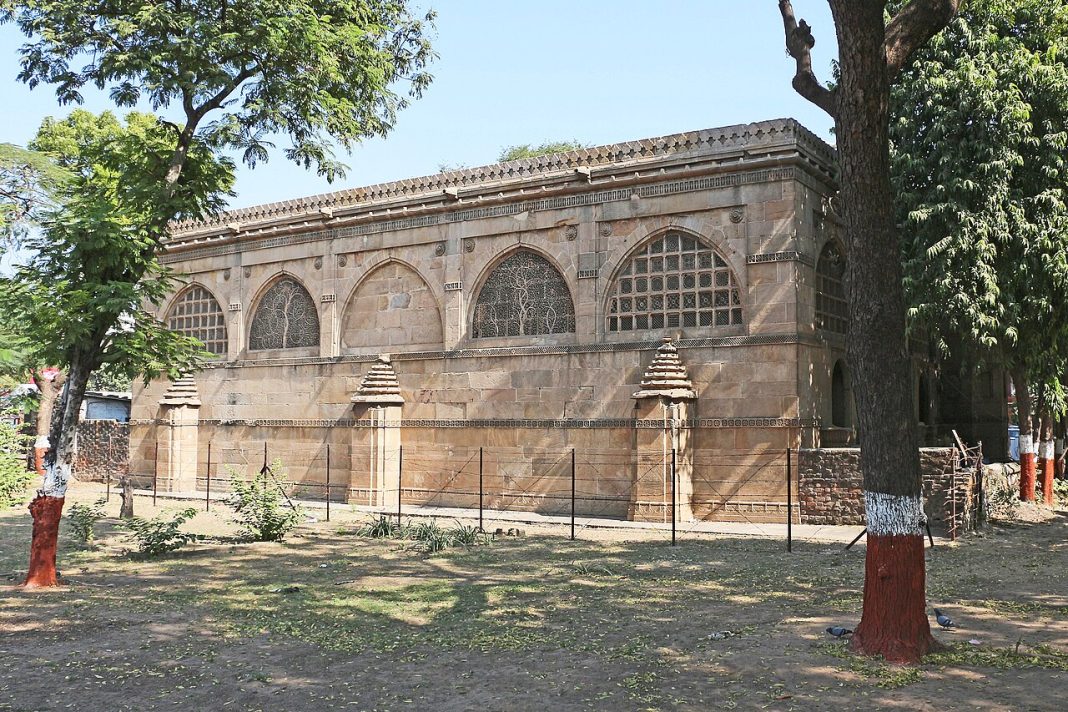

Sidi Saiyyed Mosque stands as one of Ahmedabad’s most celebrated heritage monuments, not merely for its spiritual significance but for its extraordinary artistic expression. Built in 1573 CE, this mosque houses what may be India’s finest example of stone lattice carving, the iconic jali window depicting the Tree of Life. As of 2025, the mosque remains a UNESCO World Heritage Site and continues to inspire artists, architects, and visitors from around the world.
The man behind the monument
Table of Contents
Sidi Saiyyed was an Abyssinian nobleman of African origin who rose to prominence in the court of Ahmed Shah I, the founder of Ahmedabad. His origins trace to the Habshi community, skilled warriors and administrators brought to Gujarat from East Africa. Despite his foreign birth, Sidi Saiyyed became deeply embedded in Gujarati court politics and gained sufficient wealth and influence to commission this magnificent mosque during the declining years of the Sultanate period.
The mosque was built during the reign of Ahmed Shah III, marking the final chapter of the Sultanate era in Ahmedabad (1572-1573 CE). This timing is significant, as it represents the last major religious structure constructed during the independent Gujarat Sultanate before Mughal consolidation. The mosque’s construction thus becomes a statement of enduring Sultanate power and artistic achievement.
The jali: a masterpiece in stone
What distinguishes Sidi Saiyyed Mosque is not its size or spatial grandeur, but the delicate artistry embedded in its ten stone lattice windows, particularly the famous rear jali window. These jali screens represent the pinnacle of Indo-Islamic stone carving, featuring detailed geometric and botanical motifs. The most celebrated is the Tree of Life design, where the artist has carved intertwining branches, flowers, and leaves from solid stone with such precision that the completed work resembles fine lace.
The jali windows serve a dual purpose in Islamic architecture. Functionally, they provide ventilation and light while maintaining privacy for prayer spaces. Aesthetically, they transform light into visual poetry as the sun moves through the day. The patterns cast dancing shadows on interior walls, changing throughout the day and seasons. Photography inside the mosque captures these interplay of light and shadow, creating images that have made the Sidi Saiyyed jali an enduring symbol of Ahmedabad.
UNESCO world heritage recognition
In 2017, Sidi Saiyyed Mosque received UNESCO World Heritage status as part of the Historic City of Ahmedabad designation. This recognition acknowledges the mosque’s universal cultural value and its role in documenting the evolution of Indo-Islamic architecture during a critical period of transition in Indian history. The listing ensures institutional protection and international attention for ongoing conservation.
Architectural Details
The mosque follows a hypostyle design, meaning prayer space is covered by a forest of columns supporting the roof, rather than large open spans with arches. This architectural approach, while creating visual divisions, provides structural integrity without extensive vaulting. The main prayer hall spans approximately 20 meters and contains multiple bays separated by columns of varying designs.
The structure measures roughly 30 meters by 20 meters and uses locally quarried stone for all construction. The building lacks the grand domes or lofty minarets of contemporary Mughal mosques, instead emphasizing horizontal rather than vertical drama. This restraint creates an impression of stability and permanence rather than aspiration, reflecting late-Sultanate architectural philosophy.
Visiting information at a glance
| Detail | Information |
|---|---|
| Address | Bhadra Rd, near Electricity House, Lal Darwaja, Old City, Ahmedabad 380001 |
| Entry Fee | Free (no tickets required) |
| Opening Hours | 7:00 AM to 6:00 PM daily |
| Best Time to Visit | 7:00-8:00 AM (soft morning light), 4:00-5:00 PM (golden hour) |
| Prayer Timings | Check locally; avoid midday Friday prayers |
| Photography | Permitted; respect active prayer times |
| Approximate Visit | 30-45 minutes for typical exploration |
How to reach Sidi Saiyyed Mosque
Location: The mosque is located in Lal Darwaja, one of the oldest neighborhoods of Ahmedabad’s walled Old City. This is approximately 2.5 kilometers from the city center and easily accessible from modern parts of Ahmedabad.
By Auto-Rickshaw: From Relief Road (city center), approximately 15-20 minutes and ₹80-120. Ask the driver for “Lal Darwaja” or “Sidi Saiyyed Mosque.”
By Cab: Using Uber or Ola, around 15 minutes and ₹150-200 from central locations.
By Public Transport: State transport buses serve the Old City, but infrequent. Navigation by auto or cab is recommended for first-time visitors.
Parking: Limited street parking available. Many visitors park at nearby locations and walk the final 200-300 meters through Old City lanes.
On Foot: Walking through the Old City from Bhadra Fort (500 meters) or Teen Darwaja (400 meters) offers an authentic heritage experience, though narrow lanes can be confusing for first-time visitors.
Photography and dress code
This is an active place of worship, making respectful behavior essential. As of 2025, photography is generally permitted in exterior areas and the prayer hall when not in active use, but visitors should always confirm with mosque officials before photographing.
Dress Code:
– Wear modest clothing covering shoulders and knees
– Women should carry a scarf or dupatta to cover their head when inside
– Shoes must be removed before entering the prayer hall
– Men should remove headwear unless wearing traditional Islamic prayer caps
Photography Guidelines:
– Respect active prayer times, especially Friday afternoon
– Do not photograph individuals during prayer
– The jali windows produce best photography during early morning (6:30-8:00 AM) and late afternoon (4:00-5:30 PM)
– Interior photography without flash is permitted; check with mosque staff
The IIM Ahmedabad connection
The jali window pattern of Sidi Saiyyed Mosque inspired the official logo of the Indian Institute of Management Ahmedabad (IIM-A), one of India’s premier business schools. The institution chose this intricate geometric design to represent the complexity and elegance of management education. This connection has made the jali window a symbol recognized far beyond Ahmedabad, appearing in national and international business circles.
For visitors interested in institutional heritage, IIM Ahmedabad’s campus also contains important modernist architecture designed by Louis Kahn, creating a remarkable contrast between medieval and 20th-century design approaches.
Nearby heritage sites
The Sidi Saiyyed Mosque serves as an excellent starting point for exploring Old City heritage:
- Teen Darwaja (Triple Gateway): Just 400 meters away, marks the formal entrance to historic Ahmedabad’s royal square
- Jama Masjid: About 300 meters northwest, a grand Sultanate-era Friday mosque with massive courtyard
- Bhadra Fort: 500 meters southwest, the city’s founding fortress and palace complex
- Manek Chowk: 200 meters east, historic market square famous for jewelry and sweets
- Relief Road: Modern commercial artery bordering Old City, with cafes and restaurants for refreshment
Exploring these sites in sequence creates a comprehensive understanding of medieval Ahmedabad’s urban and architectural layout.
FAQ
Q: Why is the jali window called “Tree of Life”?
A: The design depicts intertwining branches, leaves, and flowers emanating from a central trunk, creating the visual impression of a stylized tree. In Islamic tradition, the “tree of life” represents divine creation and abundance. The artist’s decision to carve this botanical motif in stone, rather than purely geometric patterns, adds a living quality to what is otherwise inanimate material.
Q: Is the mosque still used for prayers?
A: Yes, Sidi Saiyyed Mosque remains an active place of worship. Five daily prayers are conducted here, and the mosque serves the local Muslim community. The mosque experiences increased activity during Friday prayers (midday) and during Ramadan evenings. Visitors should plan their visits around prayer times for optimal access.
Q: Can women enter the mosque?
A: Yes, women are welcome to visit the mosque as long as they follow the dress code and respect prayer times. Separate prayer areas exist for men and women, as is customary in mosques. Women should carry a head covering (scarf or dupatta) and ensure their clothing is modest.
Q: What makes the jali window unique compared to other Indo-Islamic architecture?
A: While jali screens appear in many Indo-Islamic structures, the Sidi Saiyyed jali stands out for its:
– Botanical realism (depicting actual plants and leaves rather than only geometric patterns)
– Fineness of carving (thin stone tracery that appears fragile despite solid stone construction)
– Scale (the main window is large enough to be viewed from considerable distance)
– Historical timing (created during the final phase of Sultanate independence)
These factors combine to make it one of India’s most celebrated examples of medieval stone carving.
Q: Why is there no entry fee if it’s a UNESCO site?
A: As an active mosque serving a religious community rather than a museum or tourist attraction, Sidi Saiyyed maintains free entry to honor its primary purpose as a place of worship. UNESCO World Heritage status does not determine admission policies; it acknowledges cultural significance. The Archaeology Survey of India provides conservation support through government budgets rather than visitor fees.
Q: What is the best time of year to visit?
A: October to February (winter season) provides the most pleasant conditions for heritage exploration, with cooler temperatures and lower humidity. Early morning hours (6:30-8:00 AM) offer soft light ideal for photography and experiencing the jali’s light-play effects. Golden hour (4:00-5:30 PM) also provides excellent photographic conditions with warm, angled light creating dramatic shadows.
Connecting to Ahmedabad’s heritage network
Sidi Saiyyed Mosque represents a specific moment in Ahmedabad’s architectural history, the final flowering of Sultanate-era design before Mughal consolidation. Understanding this context enriches the experience. The city offers multiple entry points into medieval heritage:
The Sarkhej Roza complex 7 kilometers away displays earlier Sultanate achievement with its expansive mosque-tomb complex. The Bhadra Fort, located nearby, represents the founding moment of the city itself. The Sabarmati Riverfront provides modern context for how Ahmedabad develops and preserves its urban fabric. Visitors interested in the broader UNESCO World Heritage City experience should explore these linked monuments to understand the city’s architectural journey from medieval Sultanate to modern metropolis.
Conservation challenges and future
Like many heritage structures in India, Sidi Saiyyed Mosque faces conservation challenges. The delicate jali screens require periodic restoration to address weathering and structural stress. Learn more about historic preservation in India through the official ASI (Archaeological Survey of India) efforts. Water infiltration, salt crystallization from environmental moisture, and the stress of centuries of thermal expansion and contraction all affect the stone.
The Archaeology Survey of India, in coordination with the mosque’s community management, periodically undertakes conservation work. These interventions must balance authenticity with structural stability, a complex task requiring expertise in both heritage conservation and traditional stone-working techniques. Visitors play a role in preservation by respecting boundaries around repair zones and following guidelines to minimize impact.
Final reflections
Sidi Saiyyed Mosque invites contemplation on multiple levels. As a religious space, it offers spiritual nourishment to devotees. As an artwork, the jali window demonstrates human creativity expressed through stone. As a historical document, it records a specific moment when African-origin immigrants left permanent marks on Indian artistic heritage. As a symbol, it represents Ahmedabad itself, recognized in corporate logos and international contexts.
A visit to Sidi Saiyyed is ultimately an encounter with human ingenuity, cultural synthesis, and the enduring power of beauty created from humble material. Whether you enter as a pilgrim, photographer, historian, or simply curious traveler, the mosque offers rewards proportional to the attention you bring.
The jali window continues to cast its patterns across interior walls as it has for nearly 450 years, inviting each new generation to see themselves reflected in its intricate geometry.
Sidi Saiyyed Mosque is one of the key landmarks on the Ahmedabad heritage walk route through the walled old city. If you’re planning a full day in the heritage district, our guide covers all the major stops, walking routes, timing, and tips for first-time visitors.