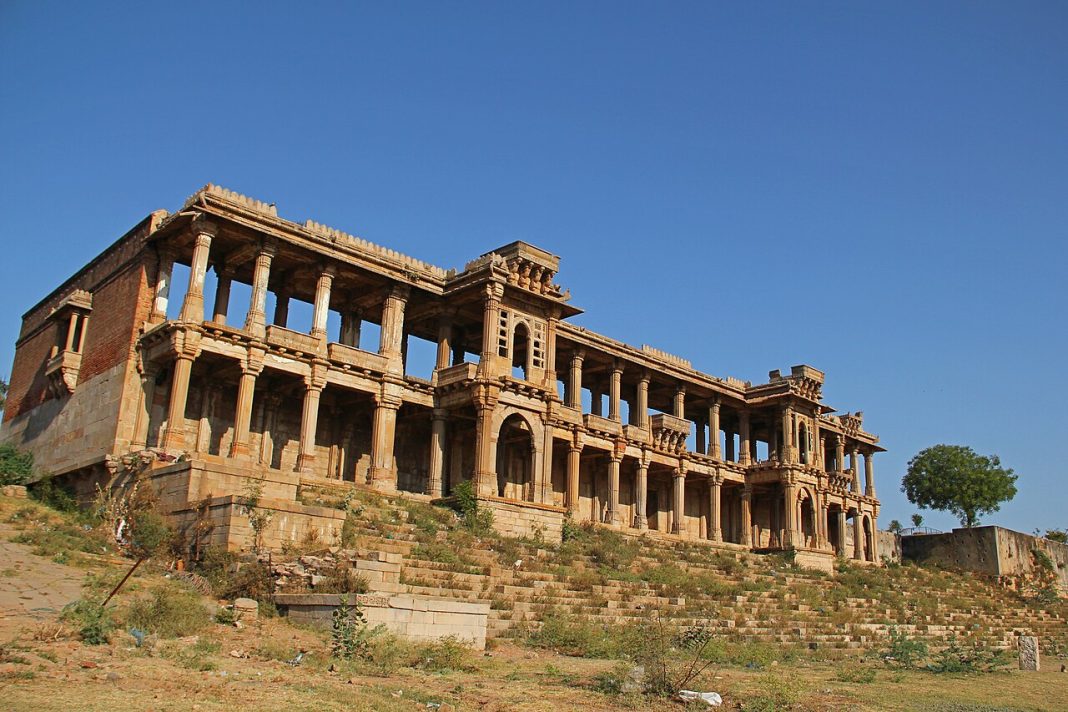

Sarkhej Roza is one of Ahmedabad’s most captivating heritage monuments, a mosque-tomb complex that blends Islamic spirituality with Indo-Saracenic architecture. Located about 7 kilometers southwest of the city center, this sacred site draws pilgrims, history enthusiasts, and architecture lovers throughout the year. As of 2025, it remains one of the best-preserved examples of early Sultanate-era construction in Gujarat.
What is Sarkhej Roza
Table of Contents
Sarkhej Roza is not a single building but rather a sprawling complex that includes a mosque, mausoleums, royal pavilions, a step-well tank, and open courtyards. Built over several centuries starting in the 15th century, the complex serves as the tomb and sanctuary of Shaikh Ahmed Ganj Baksh, a venerated Sufi saint who was the spiritual advisor to Ahmed Shah I, the founder of Ahmedabad. The site gained UNESCO World Heritage status in 2017 as part of the Historic City of Ahmedabad inscription.
Historical Significance
The roots of Sarkhej Roza trace back to the 15th century when Shaikh Ahmed Ganj Baksh settled in the village of Sarkhej. Ahmed Shah I, impressed by the saint’s spiritual wisdom, made frequent visits to seek his counsel. After the saint’s death, Ahmed Shah commissioned the construction of a magnificent tomb to honor him. The complex expanded significantly under Mahmud Begada, who deepened the sacred tank (lake), built a summer palace, and created a royal mausoleum for himself and his family.
The spiritual significance of this site made it one of the most important Sufi centers in medieval Gujarat. Many nobles and sultans chose to be buried within the complex, making it a record of centuries of Islamic heritage in the region.
Architecture: blend of two worlds
What sets Sarkhej Roza apart is its unique architectural character. The complex displays a remarkable fusion of Islamic design principles with Hindu and Jain architectural traditions, creating what scholars call Indo-Saracenic style. Many structures feature pierced stone lattice screens (jalis) instead of arches, reflecting local building practices adapted to Islamic religious requirements.
The detailed stonework, delicate balconies, and open pavilions create an aesthetic that Le Corbusier compared to the Acropolis of Athens, earning Sarkhej Roza the nickname “Acropolis of Ahmedabad.” The layout follows traditional Islamic geometry with courtyards, prayer halls, and ceremonial spaces arranged around the central sacred precinct.
Key structures within the complex
| Structure | Purpose | Notable Feature |
|---|---|---|
| Tomb of Shaikh Ahmed Ganj Baksh | Saint’s sanctuary | Octagonal dome, detailed jali screens |
| Ahmed Shah’s Mausoleum | Royal tomb | Family burial site, adjoins main mosque |
| Friday Mosque | Prayer hall | Hypostyle design, no arches |
| Summer Palace | Royal retreat | Overlooking the tank, now partially ruins |
| Sarkhej Tank | Water feature & ritual space | Step-well with 80+ steps, surrounded by platforms |
| Royal Pavilions | Administrative & ceremonial use | Open-air structures, jali screens |
Visiting Sarkhej Roza: practical details
Location: Post Jeevraj Park, Sarkhej Makarba Road, Makarba, Ahmedabad 380051
Entry Fee: Free admission (as of 2025)
Opening Hours: 9:00 AM to 6:00 PM daily
Best Time to Visit: October to February (winter months). Early morning (6:30-8:00 AM) offers soft light for photography and fewer crowds. Sunset (4:30-5:30 PM) provides golden-hour photography opportunities.
How to Reach:
– From City Center (Relief Road): About 30-40 minutes by auto-rickshaw or cab (~₹150-200)
– From CEPT (Centre for Environmental Planning & Technology): 15-20 minutes away
– From SG Highway: Take Sarkhej Road exit, approximately 10-15 minutes
– Public Transport: Limited direct bus routes; auto-rickshaw recommended
– Parking: Free vehicle parking available at the main entrance
What to expect during your visit
The complex sprawls across several acres, so plan for 2-3 hours to explore thoroughly. The main approach is through a gateway that opens onto the vast courtyard. As you move deeper, you’ll encounter the saint’s tomb with its distinctive octagonal chamber, the mosque with its prayer hall, and the tank with its elaborate steps leading down to the water level.
Walking around the tank at different times of day reveals how the changing light plays off the stonework. The water reflects the architecture, creating photographic moments throughout the day. The monument is less crowded than Old City sites, offering a peaceful atmosphere for those seeking spiritual or cultural engagement.
Photography and dress code
Photography is permitted throughout the complex, though visitors should avoid photographing during active prayers in the mosque. This is a sacred religious site, so respectful behavior is essential.
Dress Code:
– Wear modest clothing that covers shoulders and knees
– Women should carry a scarf or dupatta to cover their head when entering prayer areas
– Shoes must be removed before entering the mosque and saint’s tomb
– Some visitors prefer covering their heads throughout the visit as a mark of respect
Nearby Attractions
Within the broader Sarkhej area, you’ll find:
– Sarkhej Gam: A village quarter with traditional architecture and local markets
– Gujarat National Law University: Located near Sarkhej, this modern institution contrasts interestingly with the heritage site
– Sabarmati Riverfront: About 8km toward the city, offering nature walks and modern public spaces
– Kankaria Lake: Ahmedabad’s famous lake is about 10km away with gardens and recreational facilities
FAQ
Q: Is Sarkhej Roza a functioning place of worship?
A: Yes, the mosque and saint’s tomb remain active sites of prayer and pilgrimage. The complex handles religious gatherings throughout the year, particularly during Urs (anniversary of the saint’s death) in June, when thousands of devotees visit for special prayers and ceremonies.
Q: Why is entry free if it’s a UNESCO World Heritage Site?
A: As a protected monument under the Archaeology Survey of India and a site of active religious significance, entry to Sarkhej Roza is kept free to honor its spiritual purpose. The maintenance is funded through government heritage conservation budgets and occasional donations from devotees.
Q: What’s the best time of day to visit for photography?
A: Early morning (6:30-8:00 AM) provides soft, directional light that beautifully illuminates the stonework. The low sun angle creates dramatic shadows on the jali screens. Sunset (4:30-5:30 PM) offers golden-hour photography with warm tones reflecting in the tank. Midday sun (11:00 AM-3:00 PM) creates harsh shadows but reveals the full scale of the structures.
Q: Can women visit safely?
A: Yes, Sarkhej Roza is a welcoming site for women visitors. The presence of regular pilgrims and organized tour groups makes it safe. However, respecting the dress code and head covering is important, both for cultural respect and practical comfort, as sun exposure can be significant in summer months.
Q: How long should I plan to spend at Sarkhej Roza?
A: For a typical visit with exploration of main structures and photography, 2-3 hours is ideal. Leisurely visitors interested in studying the architecture and history may spend 3-4 hours. Pilgrims engaging in prayer and meditation often spend longer periods.
Q: Are there restrooms or facilities inside?
A: Basic restroom facilities are available near the entrance. Food and water vendors operate seasonally outside the complex, particularly on weekends. It’s advisable to carry water, especially during summer months. There are no cafes or restaurants within the monument area itself.
Preserving Sarkhej Roza for future generations
Sarkhej Roza’s inscription as a UNESCO World Heritage Site in 2017 marked official recognition of its universal cultural value. Learn more about the Historic City of Ahmedabad UNESCO World Heritage designation on Wikipedia. The Archaeology Survey of India oversees conservation efforts, though ongoing challenges include managing visitor impact, weathering of ancient stonework, and water table fluctuations affecting the historic tank.
Visitors play an important role in preservation by following guidelines, avoiding touching delicate carvings, staying on designated pathways, and respecting closed areas under restoration. The site’s management has implemented sustainable visitor practices to balance accessibility with heritage protection.
Connecting Sarkhej Roza to Ahmedabad’s heritage trail
Sarkhej Roza is an excellent addition to a broader heritage exploration of Ahmedabad. The city offers multiple UNESCO-listed monuments including the Sidi Saiyyed Mosque famous for its stone lattice windows, and Bhadra Fort, which represents royal architecture from the same era. The Sabarmati Riverfront provides a modern counterpoint to these ancient sites. Many visitors combine Sarkhej Roza with a visit to the Gandhi Ashram for a full understanding of Ahmedabad’s spiritual and cultural importance.
Exploring these interconnected heritage sites reveals how Ahmedabad developed from a Sultanate capital into a modern city while preserving its multicultural past.
Final Thoughts
Sarkhej Roza invites visitors into a world where architecture becomes a form of prayer, where stones speak of centuries of devotion, and where the past remains living and breathing. Whether you’re drawn by spiritual curiosity, architectural passion, or historical interest, the complex rewards those who take time to look closely, listen quietly, and reflect on the human values that transcend time.
The journey to Sarkhej Roza is ultimately a journey inward, offering a rare urban sanctuary where the pace of modern Ahmedabad slows, and the whispers of medieval craftsmen and devoted saints seem to echo across the centuries.
Sarkhej Roza is one of several UNESCO-recognised heritage sites across the city. For visitors exploring Ahmedabad’s walled old city on the same trip, the Ahmedabad heritage walk covers the main landmarks of the historic district in a single morning route.