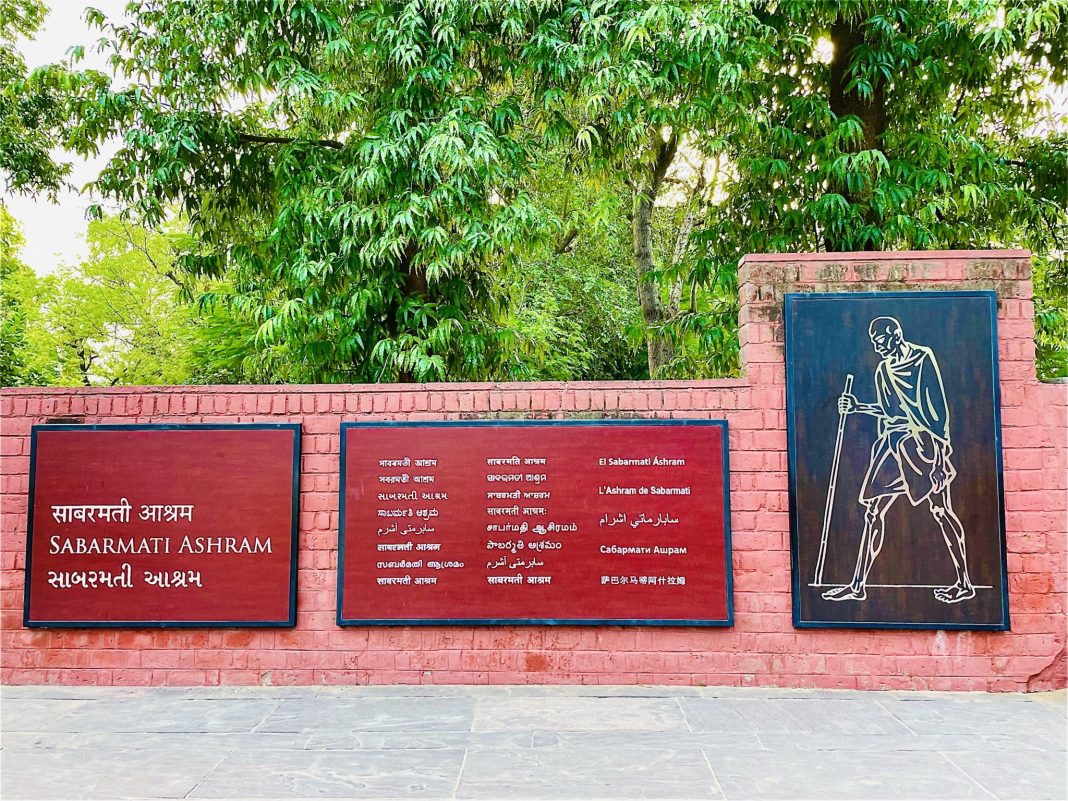

Gandhi Ashram in Ahmedabad is one of the most significant heritage sites in India. Established on the banks of the Sabarmati River, this is the place where Mahatma Gandhi lived for 13 years, conceived the philosophy of non-violent resistance, and launched the Salt Satyagraha that became a turning point in India’s independence movement. Today it functions as a memorial, a museum, and an active institution, open every day of the year with free entry.
Known formally as Sabarmati Ashram and sometimes as Satyagraha Ashram, Gandhi Ashram Ahmedabad draws visitors from across India and the world, not just as a heritage site but as a place that still carries the quiet force of its history. A visit takes 1.5 to 2.5 hours for the full complex; the museum alone warrants at least an hour.
History: from Kochrab to Sabarmati
Table of Contents
Gandhi returned to India from South Africa in January 1915 after more than 20 years working as a barrister and civil rights organiser in Natal and Transvaal. His first ashram in Ahmedabad was established in May 1915 at Kochrab, a bungalow near Paldi lent to him by a friend. But the Kochrab location was cramped and, after a plague outbreak in the neighbourhood, Gandhi decided to move.
In June 1917, the ashram relocated to its present site on the Sabarmati riverbank, about 5 km from the city centre. Gandhi chose this location deliberately. Sabarmati was at the edge of the city, offering space to practise agriculture and cottage industries. The river gave it a quality of seclusion and the open sky that Gandhi considered essential to the ashram’s purpose.
The name “Satyagraha Ashram” reflected the core principles it was founded on: truth (satya) and non-violent resistance (agraha). All residents took eleven vows on joining, covering non-violence, truth, non-stealing, celibacy, non-possession, manual labour, control of the palate, fearlessness, equal respect for all religions, opposition to untouchability, and swadeshi (economic self-reliance through locally made goods).
Gandhi lived here with his wife Kasturba from 1917 until March 12, 1930, when he set off on the Dandi March. He vowed not to return to the ashram until India had attained independence. He never returned. The ashram continued under the stewardship of associates and was formally opened as a public memorial after independence.
The Dandi March: why this place matters
On March 12, 1930, Gandhi walked out of this ashram at the head of 78 followers to begin a 241 km march to the coastal village of Dandi in Navsari district. The target was British salt laws, which taxed the production of salt and made it illegal for Indians to produce their own. On April 6, Gandhi reached the sea, picked up a lump of natural salt, and broke the law in full public view.
The Salt Satyagraha that followed mobilised hundreds of thousands of Indians across the country and drew international attention to the independence movement. It is widely regarded as the moment the British Raj lost the moral argument for its continued presence in India.
The route and events of the Dandi March are documented in detail in the ashram’s museum. A timeline panel shows each day of the march, the villages Gandhi passed through, and the growing numbers who joined or were arrested along the way.
What to see at Gandhi Ashram Ahmedabad
Hriday Kunj
Hriday Kunj is the most important structure on the complex: the modest house where Gandhi and Kasturba lived during their 13 years at the ashram. The name translates roughly as “the heart’s retreat.” The building is small and deliberately austere: a main room where Gandhi kept his charkha (spinning wheel), conducted meetings, and slept on a thin mattress on the floor; Kasturba’s adjacent room; a kitchen; a guest room; and a storeroom. The rooms are preserved as they were, glass-enclosed from public access but visible through the windows. The deliberate simplicity is striking: the man directing India’s independence movement worked from a single room furnished with a spinning wheel and a low writing desk.
The Museum
The museum at Gandhi Ashram Ahmedabad was designed by Charles Correa, one of India’s most celebrated post-independence architects, and is considered a landmark in Indian museum design. It holds three galleries.
“Gandhi in Ahmedabad” presents hand-drawn panels tracing events from Gandhi’s arrival in the city through the Dandi March. The panels include personal material: Gandhi’s accounts of his relationship with Kasturba, his self-critical reflections on his own failures, and the texture of daily ashram life. The candour is notable, particularly in a memorial context.
“My Life is My Message” traces Gandhi’s entire life in 250 photographs, from his birth in Porbandar in 1869, through his schooling, his time in England studying law, his two decades in South Africa, and the long arc of India’s independence movement to Gandhi’s assassination in Delhi on January 30, 1948. The sequence is well-curated and gives visitors who are less familiar with Gandhi’s biography a coherent account of his life.
The Painting Gallery displays paintings of Gandhi in various stages of his life: meditating, spinning, leading the Dandi March, addressing large gatherings. One notable piece is a portrait made entirely from heated groundnut shells.
Magan Niwas
Magan Niwas was the home of Maganlal Gandhi, Gandhi’s nephew and one of the most important figures in the ashram’s day-to-day operation. Gandhi described Maganlal as the soul of the ashram. Maganlal was instrumental in upgrading the design of the charkha to make hand-spinning more efficient and accessible. Magan Niwas now houses a collection of different charkha types and displays on the production of khadi, the hand-spun cloth that became the symbol of the Swadeshi movement. Visitors who assume the charkha is a single standard device typically find this exhibit genuinely surprising.
Vinoba Mira Kutir
This simple residential structure takes its name from two people who lived here at different periods. Vinoba Bhave, whom Gandhi considered a model Satyagrahi, lived in the ashram from 1918 to 1921. He went on to lead the Bhoodan movement after independence. Mira was Madeleine Slade, the daughter of a British Admiral, who was moved by Gandhi’s writings, gave up her privileged life in England, and lived at the ashram from 1925 to 1933. The structure is preserved as it was used.
Nandini Guest House
Nandini served as the ashram’s guest house and received some of the most significant figures of the independence era. Jawaharlal Nehru, Maulana Abul Kalam Azad, Rabindranath Tagore, and other leaders of the freedom movement stayed here on visits to Gandhi. The building stands as part of the preserved complex.
The Grounds and the River
The ashram’s grounds are large and well-maintained, with mature trees, flowering plants, and paths that lead down to the Sabarmati ghats. A black stone statue of Gandhi stands in the garden. Three white monkeys representing Gandhi’s principle of “hear no evil, see no evil, speak no evil” are installed in one corner. The riverbank itself offers a direct and quiet contrast to the bustle of the city just beyond the gates. The Sabarmati Riverfront, the developed promenade that now runs along much of the river’s length, is a short distance away.
Shops and Publications
A well-stocked bookshop carries Gandhi’s own writings, biographies, books on the independence movement, religious texts, children’s books, and works on philosophy. The Khadi Shop sells hand-spun and hand-woven garments. Udyog Mandir sells handmade souvenirs, printed items, and accessories.
Practical information
| Detail | Information |
|---|---|
| Address | Gandhi Ashram Road, Sabarmati, Ahmedabad 380027 |
| Timings | 8:30 AM to 6:30 PM, open all 365 days |
| Entry fee | Free |
| Photography | Permitted (respectful, no flash inside Hriday Kunj) |
| Official website | gandhiashramsabarmati.org |
| Nearest landmark | Sabarmati Riverfront / Ashram Road overbridge |
No entry fee applies to any part of the main complex, including the museum galleries. Photography is generally allowed throughout the grounds and galleries; restrictions apply inside the enclosed rooms of Hriday Kunj.
How to reach Gandhi Ashram Ahmedabad
Gandhi Ashram is located in the Sabarmati area, approximately 5 km from Ahmedabad’s old city centre and about 6 km from the railway station. Ashram Road, one of the city’s main arterial roads, leads directly to it.
By auto-rickshaw or cab from Ahmedabad Junction: around 15 to 20 minutes depending on traffic. By road from SG Highway or the western suburbs: 20 to 30 minutes. The Ahmedabad BRTS has stops along Ashram Road. Parking is available near the ashram entrance.
The ashram is a natural starting point for anyone doing Ahmedabad’s heritage walk, as several of the old city’s UNESCO-listed monuments are within a few kilometres. The Adalaj Stepwell is about 18 km north and can be combined into a half-day heritage circuit.
When to visit and how long to spend
The ashram is open year-round, including public holidays. October to February is the most comfortable period for spending time outdoors in the grounds and on the ghats.
Allow at least 90 minutes for a complete visit covering the museum, Hriday Kunj, Magan Niwas, and the grounds. The museum alone takes 45 to 60 minutes if you read the panels carefully. Arriving early in the morning (8:30 to 10:00 AM) means quieter conditions and better light for the outdoor spaces. Weekends and school holidays see larger crowds, particularly in the museum.
Audio guides are available. Guided tours can be arranged through the ashram in advance for groups.
Gandhi Ashram in the context of Ahmedabad’s heritage
Ahmedabad was designated a UNESCO World Heritage City in 2017, the first Indian city to receive that designation. Gandhi Ashram is one of the sites that anchors that status. The city’s heritage trail connects it to Mughal-era mosques, stepwells, the old walled city’s pol architecture, and the riverfront that has been central to Ahmedabad’s identity for centuries.
For visitors building an Ahmedabad heritage itinerary, the ashram pairs naturally with the city’s museums and heritage infrastructure. The museums in Ahmedabad guide covers the full range of options, from the Calico Museum of Textiles to the Shreyas Folk Museum. For an evening contrast, Manek Chowk in the old city is 4 km away and transforms into a street food market after dark.
For those extending beyond Ahmedabad, the Statue of Unity at Kevadiya, 200 km away, is the most visited day trip from the city and commemorates Sardar Vallabhbhai Patel, the Deputy Prime Minister whose role in India’s integration is directly intertwined with the independence movement that Gandhi helped to lead from this ashram.
Last verified: March 2026
Frequently Asked Questions
What are the timings of Gandhi Ashram Ahmedabad?
Gandhi Ashram (Sabarmati Ashram) is open daily from 8:30 AM to 6:30 PM, all 365 days of the year including public holidays and national holidays.
What is the entry fee for Gandhi Ashram Ahmedabad?
Entry to Gandhi Ashram is completely free for all visitors. There is no admission charge for the grounds, the museum galleries, or any of the preserved structures.
What is Hriday Kunj at Sabarmati Ashram?
Hriday Kunj is the house where Mahatma Gandhi and Kasturba Gandhi lived from 1917 to 1930. It is the most significant structure in the ashram complex. The rooms are preserved as they were during Gandhi’s residence, with his spinning wheel, low writing desk, and thin mattress visible through the glass enclosure.
Why did Gandhi leave Sabarmati Ashram and never return?
Gandhi left the ashram on March 12, 1930 to begin the Dandi March, a 241 km walk to the coast to protest British salt laws. Before departing, he vowed not to return until India had gained independence. He was assassinated in Delhi on January 30, 1948, eight months after independence, and never came back to the ashram.
Who designed the Gandhi Ashram museum?
The museum at Sabarmati Ashram was designed by Charles Correa, one of India’s most significant post-independence architects. It contains three galleries: “Gandhi in Ahmedabad,” “My Life is My Message” (250 photographs spanning Gandhi’s full life), and the Painting Gallery.
Is photography allowed at Gandhi Ashram?
Photography is allowed throughout the ashram grounds and in the museum galleries. Inside the preserved rooms of Hriday Kunj, photography through the glass is permitted but flash photography is discouraged. General outdoor photography is unrestricted.
How far is Gandhi Ashram from Ahmedabad city centre?
Gandhi Ashram is approximately 5 km from the walled old city of Ahmedabad and about 6 km from Ahmedabad Junction railway station. By auto-rickshaw from the city centre, the journey takes 15 to 20 minutes.
The walled old city — with Bhadra Fort, Jama Masjid, Sidi Saiyyed Mosque, and the historic pols — is a natural half-day extension from Gandhi Ashram. The Ahmedabad heritage walk guide covers all the major stops, timings, and the early-morning guided walk option.