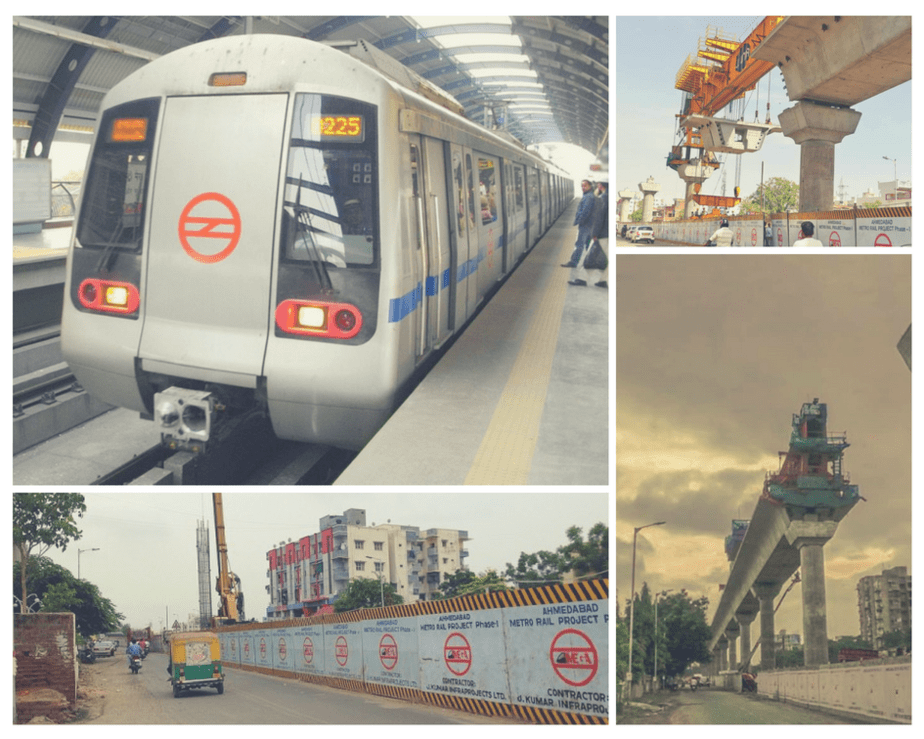

Ahmedabad now has a working metro system. After years of construction, the GMRC (Gujarat Metro Rail Corporation) has delivered 67.56 km of rail across 54 stations on 4 lines. The latest addition, the Yellow Line to Gandhinagar, opened in January 2026 and connects Ahmedabad’s city core to the state capital’s administrative and financial centers. If you live in or visit Ahmedabad, the metro is your fastest way to cross the city without cars. This guide covers all four lines, current fares, station locations, and what’s coming next.
Metro network at a glance
Table of Contents
| Line | Route | Stations | Status |
|---|---|---|---|
| Blue | Vastral Gam to Thaltej Gam | 19 | Operational |
| Red | APMC to Motera Stadium | 18 | Operational |
| Yellow | Motera to Mahatma Mandir (Gandhinagar) | 28 | Operational since Jan 16, 2026 |
| Violet | GNLU to GIFT City | 6 | Operational since Sept 2024 |
Total: 67.56 km, 54 stations, 4 lines, operated by GMRC. For official information, check the GMRC official website.
Ahmedabad Metro fares
The fare system is distance-based. You pay more for longer trips. Here’s how it breaks down:
Single-journey tokens:
– Up to 3 stations: ₹5
– 4–6 stations: ₹10
– 7–10 stations: ₹15
– 11–15 stations: ₹20
– 16+ stations: ₹25
Smart Card fares (10% discount):
– Up to 3 stations: ₹4.50
– 4–6 stations: ₹9
– 7–10 stations: ₹13.50
– 11–15 stations: ₹18
– 16+ stations: ₹22.50
Most commuters buy a smart card. They cost ₹100 (₹50 security deposit, ₹50 stored value). You can load them at any station ticket office or top-up machine. The card works for 5 years from your last recharge. If you travel daily, the 10% discount adds up quickly. Daily commuters save roughly ₹500–600 per month compared to single tokens.
You can buy smart cards at any operational station during ticket office hours. Some larger stations have multiple counters. Many locals top up their cards via the GMRC mobile app or at station machines.
Ahmedabad Metro timings
First train: 6:20 AM (all lines)
Last train: 10:00 PM (all lines)
Frequency: Trains run every 10–15 minutes during peak hours, 15–20 minutes off-peak.
The metro doesn’t run late enough for clubs or bars (which is fine in a dry state). Plan your evening return before 10 PM. On weekdays, peak hours are 7–9 AM and 5–7 PM. Avoid these if you can; trains are packed. Early morning and mid-day trains are much quieter.
Blue Line (East-West): Vastral Gam to Thaltej Gam
The Blue Line runs across Ahmedabad’s east-west axis. It’s been operational the longest and is most familiar to daily commuters.
Key stations:
– Vastral Gam (western terminus): connects to BRTS and local buses
– Kalupur Railway Station: transfer to Central Railway; useful if you’re arriving by train
– Law Garden: city center, close to shops and restaurants
– Lal Darwaza: old city, historic market area
– Relief Road: business district, near government offices
– Mahatma Nagar: residential area, local hub
– Paldi: mixed residential-commercial
– Thaltej Gam (eastern terminus): growing tech corridor, office parks
The Blue Line is 19 stations, roughly 20 km. Travel time from Vastral Gam to Thaltej Gam is about 40 minutes. It’s your main line for crossing the city north-south is handled by the Red Line. Many workers in IT parks near Thaltej depend on this line daily.
Red Line (North-South): APMC to Motera Stadium
The Red Line runs north-south. It connects the fruit and vegetable wholesale market (APMC) in the south to Sardar Patel Stadium (famous for cricket) in the north.
Key stations:
– APMC (southern terminus): wholesale market; buses and autos connect here
– Apparel Park: textile and apparel hub
– Rakhial: residential, working-class area
– New Delhi Bridge: historical crossing, connects both river banks
– Railway Station: central station, interchange point for tourists and business travelers
– Sabarmati Riverfront: the newest public attraction in Ahmedabad, with parks, restaurants, and cycling tracks. See our Sabarmati Riverfront guide for details.
– Memnagar: middle-class residential, near schools and colleges
– Paldi: overlaps with Blue Line; good for transfers
– Motera Stadium (northern terminus): world’s largest cricket ground, venue for international matches, IPL games, and concerts
The Red Line is 18 stations across roughly 18.5 km. Peak times see huge crowds from Motera after cricket matches. The Sabarmati Riverfront station connects directly to the walking and cycling tracks by the river. If you want to avoid car traffic in central Ahmedabad, this line is crucial.
Yellow Line: Motera to Mahatma Mandir (Gandhinagar)
The Yellow Line is the newest. It opened on January 16, 2026, after PM Modi inaugurated it on January 11. This line extends metro service from Ahmedabad to Gandhinagar, the state capital, 23.8 km north.
Key stations (Ahmedabad section):
– Motera Stadium (interchange with Red Line): starting point; same station as cricket ground
– Akshardham: religious and cultural complex
– Sector-10: mixed-use development
– Old Secretariat: government offices
– Sachivalaya: state secretariat, administrative center
Key stations (Gandhinagar section):
– Sector-16: residential township
– Sector-24: commercial and residential
– Mahatma Mandir (northern terminus): convention and performance center, seat of Gandhinagar’s cultural life
The Yellow Line brings Ahmedabad workers and visitors seamless access to Gandhinagar. Previously, traveling between the two cities meant battling road traffic or taking shared autos. Now it’s a straight metro ride, roughly 50 minutes end-to-end. The Sachivalaya station is especially useful if you need government services in the capital. Office workers and students commute between both cities regularly on this line now.
A branch line from GNLU links GIFT City (Gandhinagar’s financial hub). See below.
Violet Line: GNLU to GIFT City (financial district)
The Violet Line is short but strategic. It’s only 5.4 km with 6 stations, but it connects one of India’s major financial centers (GIFT City) to the metro network.
Key stations:
– GNLU (terminus): Gujarat National Law University
– PDEU: Pandit Deendayal Energy University, major research hub
– GIFT City Central: the main financial district, banks, trading floors, offices
The Violet Line opened in September 2024, before the Yellow Line completed. It’s especially useful for finance professionals, traders, and students working in GIFT City. If you’re reaching GIFT City from Ahmedabad, metro is now the preferred option over road travel. The line is modern, clean, and less crowded than central city lines. For a complete overview, see our GIFT City Gandhinagar complete guide.
How to buy tickets and smart card
Tokens (single journey):
Walk up to a ticket counter or automated vending machine at any station. Tell the staff where you’re going or use the machine to input your destination. You’ll get a token. Keep it safe; you need it to exit. Tokens are checked at exit gates. Cost is ₹5 to ₹25 depending on distance.
Smart Card:
Go to any station’s ticket office during operating hours. Pay ₹100. You’ll get a rechargeable card with ₹50 stored value (₹50 is the security deposit). Use it like a transit card. Tap at entry and exit gates. Fares auto-deduct. No more queuing for tokens. Most commuters prefer this.
Recharge your card at ticket offices, top-up machines, or the GMRC mobile app (if you have online banking linked). Cashless recharge via app is fast and works at most stations.
Mobile app:
GMRC offers a mobile app (available on iOS and Android) for checking fares, station maps, route planning, and card management. Download “Gujarat Metro Rail” from your app store. It’s helpful for first-time users and route planning.
Women’s safety:
Ahmedabad’s metro is safe for women. Dedicated women-only coaches are available during peak hours. Ladies can travel alone at any time without worry. The security staff is present, and stations are well-lit and monitored.
Phase 2: What’s coming next
The metro is expanding. Phase 2A and 2B are under design and tender stages as of March 2026.
Phase 2A — Airport Extension:
A 6 km line from Koteshwar Road to Sardar Vallabhbhai Patel International Airport. This is the most anticipated extension. Currently, there’s no direct metro link to the airport; most travelers take autos or cabs. Once complete (estimated 2028–2029), airport passengers will take metro straight from the city center. The underground section near the airport will have direct access to the terminal via lifts and escalators. Cost: approximately ₹1,800 crore.
Phase 2B — GIFT City Loop:
Further integration with GIFT City, including a 10 km line through the financial hub’s internal zones. The first 3.3 km stretch is planned. This will connect GIFT City’s residential, office, and retail areas more efficiently. Cost: approximately ₹900 crore.
Both extensions are essential for Ahmedabad’s growth. The airport extension is critical for tourists and business travelers. GIFT City expansion supports the financial sector’s rapid growth. As of early 2026, design consultancy tenders are out. Construction timelines will become clearer once contractors are finalized.
Frequently Asked Questions
Can I use my smart card on BRTS?
No. Smart cards are metro-only. BRTS (Ahmedabad’s bus rapid transit) uses a separate system. You’ll need a separate BRTS card or token.
Is the metro accessible with luggage or bikes?
Luggage is fine; most commuters carry backpacks and small suitcases. Large suitcases take up space during peak hours. Bicycles are not allowed inside metro trains. You can take folding bikes if collapsed and stored.
What if I touch out at the wrong station?
At automated gates, the fare will be for the zone you exited. If you exit accidentally or go past your stop, you’ll be charged extra. Speak to staff at the exit gate; they can sometimes adjust fares for genuine mistakes, but it’s not guaranteed.
Is the metro operational on public holidays?
Yes. Metro runs on all days, including state and national holidays, with normal timings (6:20 AM to 10:00 PM).
Can I buy a smart card online?
Not yet. You must visit a station to purchase your first card. You can recharge online via the app if your card is already registered.
Getting around Ahmedabad: Metro vs. BRTS
Ahmedabad’s metro and BRTS (Bus Rapid Transit) are two separate systems. Metro is faster for long distances and fixed routes. BRTS covers more neighborhoods with buses. Most residents use both depending on their destination. Metro is faster, BRTS is more flexible but slower. If you’re new to the city, start with the metro for main routes and BRTS to reach smaller areas.
The metro is changing how people move through Ahmedabad. After years of announcements and delays, the system is delivering real commute time savings. Whether you’re a daily office worker, visiting the city, or exploring new neighborhoods, the metro is now the quickest way to cross Ahmedabad without sitting in traffic.