If you’ve driven past the gleaming towers along the Sabarmati River near Gandhinagar lately, you’ve probably wondered: What exactly is GIFT City, and why does everyone suddenly want to move there? It’s not another real estate bubble or a pharma hub like Ahmedabad has been. It’s something more ambitious,and honestly, more confusing if you don’t live within it. This guide cuts through the jargon and tells you what it’s actually like to consider GIFT City as an Ahmedabad person: whether you’re thinking about working there, moving your family, grabbing lunch, or just understanding what all the fuss is about.
What Is GIFT City, Actually?
Table of Contents
Let’s start with the basics, because the marketing speak can get overwhelming. GIFT City stands for Gujarat International Finance Tec-City, and it’s India’s first operational greenfield smart city combined with an International Financial Services Centre (IFSC). That fancy title means it’s a specially designated zone where global financial companies, tech firms, and trading outfits can operate with unique tax benefits and regulatory freedom that don’t apply elsewhere in India.

Launched in 2015 and becoming operational in 2017, GIFT City has grown from a cluster of ambitious renderings into something genuinely real. As of early 2026, it hosts over 1,000 registered entities (crossing that milestone in December 2025), including insurance firms, funds, and over 100 foreign companies. The sheer scale of what’s been built in less than a decade on the banks of the Sabarmati is hard to ignore when you drive past it.
The city sits about 20 minutes from the SG Highway and roughly 12 kilometres from Ahmedabad airport, positioned as a bridge between Ahmedabad’s existing business ecosystem and the global financial world. While it’s technically in the Gandhinagar district (hence the “Gandhinagar” in the name), it’s very much a satellite of Ahmedabad for those of us living here. It’s close enough to be commutable, far enough to feel like a separate world.
Why Did GIFT City Happen?
If you’re wondering why Gujarat needed yet another business zone, the answer involves India’s complex financial regulations and ambitions. For decades, if Indian financial companies wanted to operate on global markets,trading currencies, managing international funds, offering cross-border insurance,they had to do it from offices abroad. GIFT City changed that by creating a zone with global-standard regulations and zero restrictions on foreign exchange. It’s essentially a piece of the world’s financial system nestled in Gujarat.
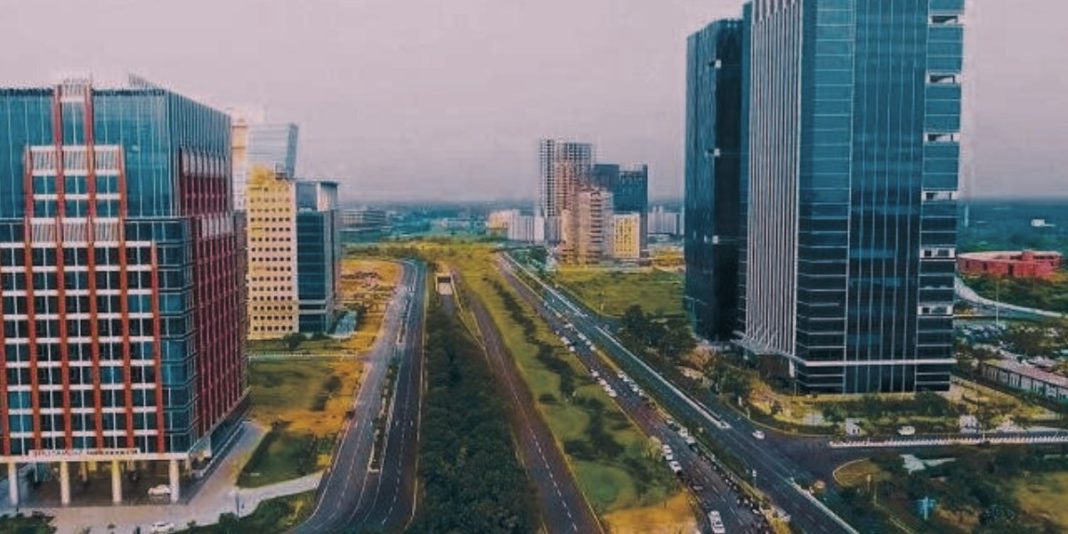
The visionaries behind it wanted to create something more than just office space for number-crunchers. The master plan originally covered 886 acres but is now expanding to over 3,300 acres. Every building follows strict green standards (it’s got a Platinum rating under IGBC Green Cities standards). The infrastructure is genuinely futuristic,underground utility tunnels that eliminate the need to dig up roads, district-wide cooling systems, automated waste management, and a planned metro extension that’ll eventually connect directly to Ahmedabad.
Who’s Actually Moving There?
GIFT City has attracted the financial heavy hitters you’d expect: JP Morgan, Standard Chartered, Deutsche Bank, Citibank, HSBC, Barclays, and Bank of America all have operations there. But it’s not just finance anymore. TCS is set up with over 5,000 employees, and you’ve got Google, Capgemini, Wipro, IBM, and LTI Mindtree too. The diversity is growing, which changes the vibe from “boring finance hub” to something closer to a real tech and business ecosystem.
The bigger shift started with Gujarat’s Global Capability Centre (GCC) Policy for 2025-30, which is designed to attract hundreds of GCC units,essentially overseas offices for multinational companies that do R&D, customer support, and engineering work. The state is aggressively targeting these because they create quality jobs, attract talent, and bring international standards to local operations. If you’re in software, finance, IT services, or consulting, there’s a non-trivial chance your next job offer could be from GIFT City rather than Bangalore or Pune.
The projected job creation is ambitious: officials claim GIFT City could eventually support a million jobs across all sectors. That might sound like hype, but when you see the scale of construction and the talent pipeline, it’s not entirely fanciful. The question for Ahmedabad locals is whether these jobs will actually flow down to us or remain concentrated among relocated professionals.
Working in GIFT City: What You Should Know
If you’re considering a job in GIFT City, there are several things worth understanding beyond the salary figure.
First, the tax benefits are real. Companies operating in the IFSC get corporate tax rates significantly lower than those in mainland India, which often translates into better compensation packages for employees. From April 2026, mutual funds and ETFs can relocate to GIFT City without capital gains tax, which is opening up entirely new opportunities in the asset management space. If you work in finance here, your take-home might be noticeably higher than comparable roles in Mumbai or Delhi.
The second thing to understand is the commute dynamic. GIFT City is about 20-25 minutes from central Ahmedabad via the SG Highway if traffic cooperates, but that’s the best-case scenario. During peak hours, you’re looking at 45 minutes to an hour. Some companies offer shuttle services, and there’s ongoing talk of a metro extension, but that’s still years away. Many employees choose to relocate to GIFT City proper or to Gandhinagar, which shifts the calculus of whether the job makes sense for you financially.
Third, the work culture is genuinely multinational. These companies operate global hours, follow international standards, and hire globally. You’ll work alongside (and often under) international managers and clients. Your annual reviews, leave policies, and HR processes are typically more formal and standardised than traditional Indian offices. Whether that’s liberating or suffocating depends on your personality.
For detailed information about specific companies hiring and sector-wise opportunities, see
Living in GIFT City: Is It Worth the Move?
This is where the calculus gets personal. GIFT City is rapidly developing residential options, from luxury apartments to planned family communities. The property appreciation has been stunning,94% value increase over a decade,but that also means buying in isn’t cheap, and rental costs have climbed accordingly. Depending on the building and location, monthly rents currently range from about ₹18,000 on the lower end to ₹50,000+ for premium apartments.
The decision to move your family here depends on several factors. Schools are present but limited. Jamnabai Narsee School is operational, and Deakin University has a campus for international education. If you have school-age kids or care about international curriculum options, GIFT City is improving rapidly, but you’re not yet at the density of choice you’d find in Bangalore’s expat zones. For more details on schools and education options, check [INTERNAL: /gift-city-schools/].
Healthcare is expanding. A Lilavati Hospital branch has been announced, though construction timelines have stretched beyond original targets. Right now, for serious medical needs, most residents still head to Ahmedabad proper, but that’s expected to change as the city matures. See [INTERNAL: /gift-city-hospitals-healthcare/] for details on current and planned healthcare facilities.
Entertainment and amenities are where GIFT City’s ambitions really show. There’s a proposed 158-metre Ferris wheel (dubbed “GIFT Eye,” which would be taller than the London Eye) and various restaurants and entertainment zones under development. It won’t feel like a ghost town of office workers,there’s genuine city-building happening here. For what you can actually do right now in your downtime, check [INTERNAL: /gift-city-things-to-do/].
The lifestyle question is real though: Are you comfortable trading the organic social networks, established restaurants, and cultural familiarity of Ahmedabad for the shiny newness of GIFT City? Some people find it exhilarating. Others find it isolating until the city matures and a genuine community forms.
Eating and Drinking in GIFT City
One of the biggest shifts for GIFT City came in December 2025 when the liquor policy changed. It’s no longer quite the dry zone it was when the city launched. Permits were scrapped for outsiders, essentially normalising alcohol availability for residents and workers. This small policy change actually signals something bigger: GIFT City is moving away from being a sterile financial hub toward becoming an actual living city where people want to spend their evenings.
The restaurant and café scene is growing, though it’s still heavily skewed toward high-end options catering to corporate professionals. You’ll find international chains, modern Indian restaurants, and speciality coffee shops opening up. It’s not Ahmedabad’s chaotic, affordable food culture yet, but the diversity is increasing. Prices tend to be about 20-30% higher than comparable Ahmedabad venues, which is something to budget for if you’re working and eating here daily.
For specifics on current restaurants, cafés, and dining options, including which places are worth the premium, see [INTERNAL: /gift-city-restaurants-cafes/].
Getting There: The Commute Reality
Let’s address the practical logistics since this is where many local professionals will make or break their decision.
From central Ahmedabad (SG Highway junction area), GIFT City is about 12-14 kilometres via the direct highway route. In light traffic, that’s genuinely 15-20 minutes. During rush hours, it stretches to 45-60 minutes, depending on how congested the SG Highway is getting that day. From Thaltej or Maninagar, you’re looking at slightly longer commutes, probably 30-45 minutes in normal traffic.
The real game-changer is the Ahmedabad Metro Violet Line, which became operational in January 2026 and connects directly to GIFT City. The full ride takes about 55-60 minutes from the APMC station, and a ticket costs just ₹35. Trains run from approximately 7:18 AM to 6:38 PM. For anyone commuting daily, this changes the math entirely, no traffic stress, predictable timing, and a fraction of the cost of driving or taking cabs. It’s not as fast as driving in light traffic, but it’s far more reliable during rush hours.
Beyond the metro, company shuttle services operate from various Ahmedabad pick-up points, and cabs/autos are readily available. Many companies also offer flexible arrangements, a few days in GIFT City, the rest remote, which makes the commute sustainable long-term.
For detailed commute options, transit information, and time estimates from different parts of Ahmedabad,
GIFT City vs. Staying in Ahmedabad
This is the real conversation many of us are having. If you’ve been offered a job in GIFT City, you’re probably weighing it against staying in your current Ahmedabad job (or job market). Beyond just salary, here are the honest trade-offs:
GIFT City wins on: Tax-advantaged compensation, global work standards, shiny new infrastructure, real estate appreciation potential, access to multinational companies, and the energy of building something new.
Ahmedabad wins on: Lower cost of living, established social networks, cultural events and food scene, educational institutions, healthcare density, and the comfort of an already-functioning city.
The honest answer is that it depends entirely on your career stage, family situation, and what you actually want from your life. For a detailed comparison.
What’s Coming Next: The Expansion
GIFT City’s story isn’t done,honestly, it’s just getting interesting. The master plan expansion from 886 acres to 3,300+ acres means what you see now is still just the beginning. New residential zones are being built, retail and entertainment precincts are expanding rapidly, and the ecosystem is maturing beyond just financial services into tech, consulting, and global business services.
Some infrastructure milestones are already here, the Ahmedabad Metro Violet Line to GIFT City went live in January 2026, fundamentally improving daily connectivity. What’s coming next includes riverside development with parks, entertainment, and cultural spaces. The universities will expand, the healthcare facilities will multiply, and the residential options will diversify.
For a deeper dive into expansion plans, infrastructure projects, and what GIFT City could look like by 2030-2035, see
The Tax Benefits You Actually Need to Know
If you’re considering a financial role or entrepreneurial opportunity in GIFT City, the tax framework is crucial to your decision. The IFSC structure provides significant corporate tax advantages, but it’s complex. From April 2026, the relaxation on mutual funds and ETFs relocating without capital gains tax opens up entirely new opportunities for investment professionals.
However, tax laws are always evolving, and the specifics depend on your employment structure, the nature of your company, and whether you’re holding residential status in GIFT City or mainland India. Don’t make a decision based on my oversimplification here.
For a comprehensive breakdown of tax benefits, residential status implications, and what different employment structures mean for you, see [INTERNAL: /gift-city-tax-benefits/].
The Honest Assessment
GIFT City is real. It’s not a speculative bubble or a government fantasy. It has genuine companies, genuine jobs, genuine residents, and genuine infrastructure. It’s attracting global talent and creating opportunities that didn’t exist in Gujarat before.
The question for Ahmedabad locals isn’t whether GIFT City is successful,it clearly is. It’s whether it makes sense for you. That depends on where you are in your career, what you value in a city, whether your industry is growing there, and whether the commute and lifestyle trade-offs are worth it.
For many of us, GIFT City will be a permanent part of the Ahmedabad metro area,a satellite business hub that some of our colleagues work in while the rest of us stay put. For others, it’ll be the next big adventure. The infrastructure is good enough, the opportunities are real enough, and the growth trajectory is steep enough that it’s worth seriously considering if the right opportunity comes along.
The best time to make this decision is when you have an actual job offer in hand, not just hypotheticals. And when you do, explore the deeper resources we’ve linked throughout,the specific details of commute, housing, schools, and compensation matter more than the big-picture story.
Quick Reference: GIFT City at a Glance
| Aspect | Detail |
|---|---|
| Official Name | Gujarat International Finance Tec-City |
| What It Is | India’s first operational greenfield smart city + International Financial Services Centre |
| Location | Sabarmati River banks, Gandhinagar; 20 min from SG Highway, 12 km from airport |
| Current Size | 886 acres (expanding to 3,300+) |
| Current Scale | 1,000+ registered entities (as of Dec 2025), 100+ foreign companies |
| Major Employers | TCS (5000+), JP Morgan, Standard Chartered, Google, Capgemini, Wipro, IBM, Citibank, HSBC, Deutsche Bank |
| Green Certification | Platinum rating, IGBC Green Cities standards |
| Rental Range | ₹18,000 – ₹50,000+ monthly for residential |
| Property Appreciation | 94% over the past decade |
| Job Potential | Targeting 1 million jobs across all sectors |
| Schools Present | Jamnabai Narsee (operational), Deakin University |
| Hospitals | Lilavati Hospital branch under development |
| Key Policy | Liquor permits scrapped (December 2025); GCC Policy 2025-30; Mutual funds tax-neutral relocation (April 2026) |
| Infrastructure | Utility tunnels, district cooling, automated waste, Metro Violet Line (operational Jan 2026) |
Is GIFT City actually operational, or is it still under construction?
It’s both. Core financial infrastructure and offices are fully operational, with hundreds of companies actually working there right now. But the broader city,residential zones, entertainment, and healthcare,is still under active development. You won’t feel like you’re in a ghost town, but you also won’t have the full array of amenities that an established city offers.
Can I commute from Ahmedabad every day, or do I need to relocate?
You can absolutely commute. By car, it’s 15-20 minutes from the SG Highway area in light traffic, though rush hour stretches that to 45-60 minutes. The bigger news: the Ahmedabad Metro Violet Line to GIFT City went operational in January 2026. The ride takes about 55-60 minutes end-to-end at ₹35, and it’s stress-free compared to driving. Many companies also offer shuttle services and flexible WFH arrangements. Daily commuting is very feasible now.
Are the tax benefits worth taking a job in GIFT City if the salary is just marginally higher?
This is genuinely individual. The tax benefits are real, but they don’t apply uniformly to all jobs, mostly to finance and financial services roles. If you’re in IT or consulting, the salary itself is what matters. Also factor in the cost of longer commuting or relocating your family. Sometimes the tax benefit sounds better in theory than it feels in practice.
Is it safe for families to live in GIFT City?
Yes, absolutely. It’s actually quite safe,well-planned streets, security infrastructure, gated residential communities. The limiting factors aren’t safety but rather school options and social infrastructure maturity. It’s safe but still relatively isolated as a city environment.
Why is the property at Gift City appreciating so much?
A combination of factors: limited supply of premium commercial-residential spaces, genuine economic activity creating demand, infrastructure development, tax incentives attracting relocation, and the fact that it’s still perceived as a growth story. The 94% appreciation over a decade is real but not unlimited,property markets always balance eventually.
For a dedicated guide on where to drink in GIFT City, the three licensed hotel and club venues, what changed in December 2025, and the nearest permit wine shops in Gandhinagar, see our GIFT City and Gandhinagar alcohol guide.
What’s the actual job market at GIFT City, like for someone without finance experience?
Growing rapidly. The GCC Policy is bringing tech, consulting, and business services companies in significant numbers. If you’re in IT, engineering, design, customer support, or operations, there are genuine opportunities. But it’s not yet as diverse as Bangalore or Hyderabad. Finance and financial services still dominate.
The Bottom Line
GIFT City is one of those developments that changes the conversation about career possibilities and lifestyle choices for Ahmedabad professionals. It’s not for everyone, and it doesn’t need to be. But it’s real enough, developed enough, and opportunity-rich enough to deserve serious consideration if the right moment comes along.
The best move is to visit, spend a few hours there, grab a meal, walk the streets, and feel whether it’s the kind of place that energises you or deflates you. Then make your decision based on actual opportunity and fit, not hype.
Your Ahmedabad will still be here if you decide GIFT City isn’t for you. And if you do make the jump, you’ll be part of something genuinely interesting happening in Gujarat.